
Summary (Identifying Authenticity: Core Values vs Societal Conditioning)
To separate personal values from family, you must perform a “Value Audit.” This involves identifying “introjected” beliefs—values you’ve swallowed whole to maintain safety or belonging—and testing them against your lived experience. Authenticity isn’t about rebelling for the sake of it; it’s about distinguishing between inherited obligations and chosen principles. If a value feels like a “should” that induces guilt, it’s likely societal or familial conditioning. If it feels like a “must” that provides peace, it’s likely a core value. True autonomy begins when you stop asking “Is this right?” and start asking “Is this mine?”

The Costume Party Nobody Invited You To: Why Your “Self” Feels Like a Hand-Me-Down
I remember sitting in a high-rise office ten years ago, staring at a spreadsheet that felt like a death warrant. I had the title. I had the salary. I had the “respectable” life my father had spent thirty years engineering for me. By every external metric, I was winning. But inside? I felt like a ghost haunting my own life.
I was living in a masterpiece painted by someone else.
Most of us aren’t living; we are performing. We are walking around in “identity suits” tailored by our parents, our zip codes, and our Instagram feeds. We call it “being a good person” or “being successful,” but usually, it’s just high-level assimilation. We’ve been conditioned to mistake belonging for authenticity.
Here is the “Deboism” truth: You cannot be truly loved if you are never truly known. And you cannot be known if you are hiding behind the values your family gifted you like a sweater that’s two sizes too small and incredibly itchy.
Separating your personal values from your family isn’t an act of betrayal. It’s an act of birth. We spend the first two decades of our lives being sponges, soaking up the “shoulds” and “musts” of the people who raised us. Then, we spend the rest of our lives wondering why we feel anxious, hollow, or perpetually “off-track” even when we’re doing everything “right.”
The “off” feeling? That’s your soul rejecting a foreign kidney.
We’ve been taught that family loyalty means value-alignment. It doesn’t. You can love your mother and realize her obsession with “financial security at all costs” is actually a trauma response that doesn’t fit your desire for creative risk. You can respect your lineage while realizing their definition of “strength” is actually just repressed grief.
This isn’t about a teenage-style rebellion. It’s about an adult-style excavation. We’re going to pick up every “truth” you hold and look for the manufacturer’s label. If it says “Property of My Parents’ Unmet Dreams,” we’re putting it down.

Section 1: The Pillar: Inherited Identity vs. The Architecture of the Soul
To understand how to separate personal values from family, we have to look at Introjection. This is the psychological equivalent of swallowing a Lego. When we are children, we don’t have the cognitive filters to say, “I disagree with my father’s view on vulnerability.” We simply swallow his view to survive and stay connected to the “tribe.”
These swallowed beliefs eventually become the “inner critic.” When you think about quitting your job to paint, and a voice screams “That’s irresponsible!”, that isn’t your conscience. It’s a recording of your Uncle Frank from 1994.
The Taxonomy of Conditioning
Conditioning usually falls into three buckets:
- The Survival Values: These are passed down through “scarcity.” “Work hard, don’t complain, and keep your head down.” These served your ancestors during depressions or wars, but they might be suffocating your need for self-expression today.
- The Reputation Values: These are about the “Family Brand.” “What will the neighbors think?” This is the death of authenticity. It prioritizes the external image over internal integrity.
- The Moral “Shoulds”: These are often tied to religion or tradition. They aren’t necessarily “bad,” but if you haven’t opted into them as an adult, they are just scripts you’re reciting.
The difference between a Value and Conditioning is how it feels in the body. A value feels like an anchor—it grounds you. Conditioning feels like a tether—it restricts you. One gives you the power to say “No” to the world; the other takes away your power to say “Yes” to yourself.
We aren’t here to burn the house down. We’re here to renovate it so you can actually breathe the air inside.

Section 2: The Anatomy of the Social Mask
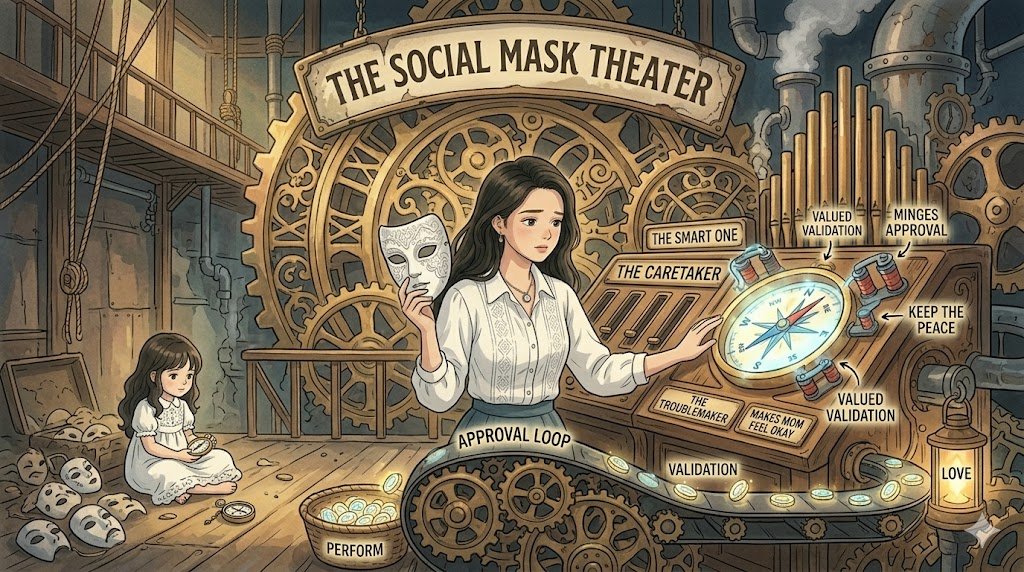
We are born into a pre-existing theater. Before you could even speak, your “role” was already written. You were the “smart one,” the “caretaker,” the “troublemaker,” or the “one who makes Mom feel okay.” This is where the social mask begins.
The mask isn’t a lie—it’s a survival strategy. In the wild, if a young animal doesn’t fit with the pack, it dies. In a modern family, if a child doesn’t align with the family’s core narrative, they face “emotional exile.” This might look like the cold shoulder, subtle sarcasm, or the “we don’t do that in this family” lecture.
Over time, you stop distinguishing between the mask and your face. You start making career choices, relationship decisions, and even political stances based on what will keep the peace at Thanksgiving. This is called the Approval Loop. It’s a closed circuit: you perform, you get “love” (which is actually just validation), and you repeat. The cost? Your internal compass starts to spin because it’s being redirected by everyone else’s magnets.
Section 3: The Mechanical Separation (The Audit)
To stop the spin, you have to look at your “values” under a microscope. Most people say they value “Honesty,” but if they are lying to themselves about being happy in their marriage to please their religious parents, do they actually value honesty? Or do they value Compliance?
We need to differentiate between Introjected Values (the Lego you swallowed) and Identified Values (the ones you’ve tested in the fire).
- Introjected: “I must be successful so my parents feel like they succeeded.”
- Identified: “I value competence because I enjoy the feeling of mastery.”
One is a burden; the other is a fuel.
The Reality Check: Why This Fails
Here is the part most self-help gurus skip: Separating your values from your family is going to hurt. It isn’t a clean, cinematic “aha” moment. It’s a messy, guilt-ridden, “I feel like a terrible person” marathon.
Logically, you know you’re allowed to have your own life. But your nervous system doesn’t care about logic. When you start setting boundaries or admitting you don’t care about the things your family prizes, your body will react like you’re being hunted by a tiger. You will feel a profound sense of “unbelonging.”
Most people quit here. They hit the wall of “Family Guilt” and scurry back to their old roles because the discomfort of authenticity is higher than the discomfort of the mask. You have to realize that the guilt isn’t a sign you’re doing something wrong; it’s just the sound of the old conditioning breaking. Growth is non-linear. You’ll have a week of feeling free, followed by a Sunday dinner that makes you feel six years old and powerless again. That’s not failure. That’s the process.

The Value Differentiation Framework
Use this table to audit the “truths” you currently live by.
| The Inherited Belief (Conditioning) | The Source / “The Why” | The Lived Reality (Your Truth) | The New Chosen Value |
| “Rest is for the lazy.” | Dad’s blue-collar scarcity. | I am burned out and resentful. | Sustainable Energy |
| “Never air dirty laundry.” | Mom’s fear of social judgment. | I feel isolated in my struggles. | Authentic Connection |
| “Security is the only goal.” | Generational trauma/poverty. | I am bored and dying inside. | Calculated Risk |
| “Conflict is ‘bad’ behavior.” | Family’s desire for “peace.” | I never get my needs met. | Healthy Confrontation |
Debo’s Field Notes: The “Should” Detector
Listen for the word “Should” in your internal monologue. “I should want this promotion.” “I should visit home this weekend.” Whenever you hear a “should,” stop. Ask: “Whose voice is that?” If it’s not yours, you’re currently being a ventriloquist’s dummy for your ancestors.
Debo’s Field Notes: The Cost of Admission
Sometimes, the price of your authenticity is the disappointment of people you love. If they only love the “version” of you that complies, they aren’t actually loving you—they are loving their own reflection. You have to decide if you’d rather be a loved character in someone else’s play or a misunderstood protagonist in your own life.
Section 4: The Logic of Alignment
Once you’ve identified the junk, you have to build the new structure. This isn’t just about “finding yourself”—it’s about deciding yourself. Authenticity is an active verb. It’s the daily practice of aligning your calendar with your values.
If you say you value “Freedom,” but you have a 30-year mortgage and a job you hate to pay for it, you don’t have freedom. You have a very expensive cage. The logic of alignment requires a “Life De-clutter.” You must remove the activities and commitments that were bought with “social currency” (doing things for the sake of looking a certain way).

Section 5: The Concept of “Legacy Debt” (The Ghost in the Machine)
Most psychological frameworks treat value-alignment as a cognitive exercise—a simple matter of choosing List A over List B. Humanity Deboism views it as an Emotional Debt Settlement.
We often operate under a subconscious contract I call “Legacy Debt.” This is the unspoken feeling that because your parents sacrificed their youth, their dreams, or their stability to raise you, you owe it to them to be happy on their terms. You feel like a “bad investment” if you choose a path that makes them nervous. You aren’t just choosing a career or a lifestyle; you are trying to retroactively validate their struggles.
Here is the Information Gain: You cannot pay back a debt you didn’t sign for with a life you didn’t choose. When you live by their values to “repay” them, you aren’t honoring their sacrifice; you are duplicating their misery. If your mother gave up her art to raise you, and you give up your passion to be “secure” for her sake, the net result is two generations of buried dreams. The debt is never paid; it’s just refinanced at a higher interest rate for your own children.
Breaking this cycle requires a radical shift in perspective: The only way to truly honor the people who came before you is to become the most expanded, authentic version of yourself. Your joy is the only “dividend” that actually justifies their sacrifice. Anything less is just a polite form of self-sabotage.

Section 6: The “Body-Exhale” Test (Identifying the Soul Value)
If you’re struggling to figure out what is actually yours versus what was programmed, stop looking at your brain. Your brain is a world-class liar. It has been trained for decades to tell you what you “should” feel to stay safe.
Instead, look at your nervous system.
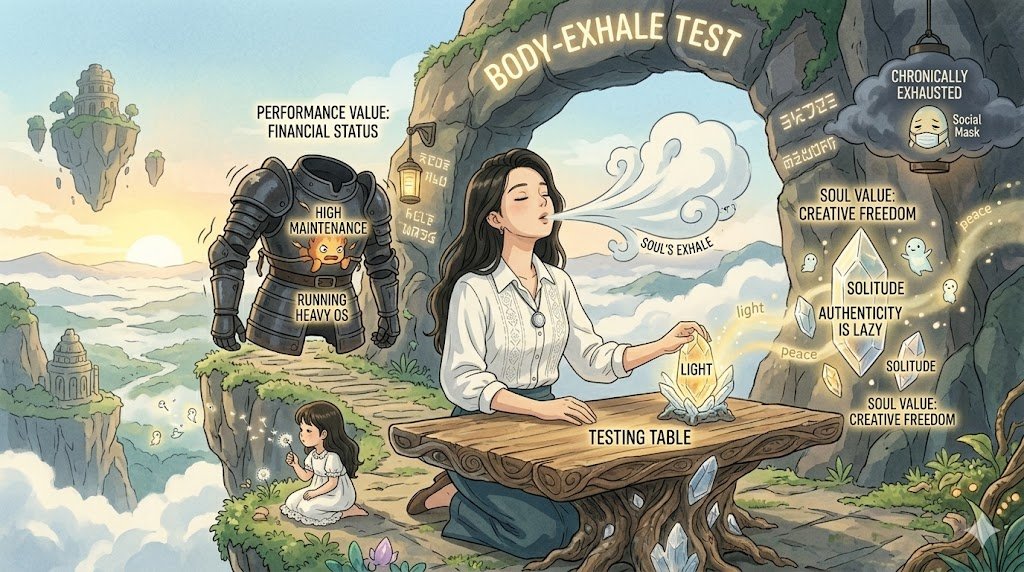
In the Humanity Deboism philosophy, we use the Body-Exhale Test. Think about a value you claim to hold—let’s say “Financial Status.” Visualize yourself achieving a massive amount of it. Now, pay attention to your chest and shoulders.
- Does your body tighten? Do you hold your breath? That’s a Performance Value. It’s high-maintenance. It requires armor.
- Now, think of something that makes you feel “light,” even if it’s “unproductive” or “unimpressive” to your family. Maybe it’s “Creative Freedom” or “Solitude.” Does your body instinctively exhale? Do your shoulders drop? That’s a Soul Value.
Authenticity is actually “lazy” in the best way possible. It requires significantly less caloric energy to be yourself than it does to maintain the “Social Mask.” If you are chronically exhausted despite “doing everything right,” it’s because you are running a heavy OS (Conditioning) on hardware that was designed for a much simpler, more honest program (Authenticity).
The Practice Bridge: From Philosophy to Bone-Deep Change
Understanding that you’ve been living someone else’s life is a heavy realization. It’s the “Red Pill” moment. But logic alone won’t change the way you react when your mother asks, “So, are you still doing that little hobby instead of getting a real job?” To move these ideas from your head into your bones, you need to engage in the “Value Decoupling” exercise. You need to learn how to stand in the fire of “disappointing others” without catching flame yourself.
This isn’t about affirmations; it’s about tactical, ego-stripping practice. We’ve designed a specific, step-by-step assignment for today to help you navigate the “Identity Audit” and handle the inevitable pushback from your social circle. This is where the theory gets messy, and where the real “you” finally starts to breathe.
[Click Here for the Day 4 Assignment: The Identity Audit & Boundary Blueprint]
(Note: If you are following the 60-day syllabus, do not skip this. Your “True North” is buried under the “shoulds” we are about to excavate.)
The Next Chapter: From Clearing the Brush to Finding the Path
We’ve spent this time doing the “heavy lifting” of the soul—the excavation. We’ve looked at the “Legacy Debt” you’ve been trying to pay and the “Social Masks” you’ve been wearing until your face ached. By now, you should be standing in a bit of a clearing. It might feel cold. It might feel quiet. That’s because the constant hum of “should” has finally been turned down.
But here is the reality: Clearing the weeds doesn’t automatically mean you know where to walk.
A lot of people reach this stage of the Humanity Deboism journey and feel a sudden, sharp pang of panic. They’ve successfully separated their personal values from their family’s expectations, but they look down and realize they don’t actually know what their values are. They’ve spent so long being a reaction to someone else’s action that “the self” feels like a blank whiteboard.
If you feel “empty” right now, don’t mistake that for failure. It’s actually the first time in your life you’ve had enough space to house a real identity.
In our next session, we are going to address the “missing” feeling. We are going to talk about why your “True North”—that internal compass that is supposed to guide your every move—feels like it’s broken or completely absent. The truth is, it isn’t missing. It’s just been buried under layers of static that we haven’t addressed yet. We’ve identified the “Who I’m Not.” Tomorrow, we start the rigorous, beautiful process of “Who I Am.”
FAQ
1. How do I tell my parents my values have changed without starting a war?
A. You don’t necessarily need to “announce” your values; you need to live them. If your value is “Autonomy,” simply start making autonomous choices. If they challenge you, use “I” statements: “I’ve realized that [Action] is what makes me feel most grounded right now.” You aren’t asking for permission; you’re providing an update.
2. Is it possible to have different values and still stay close to my family?
A. Yes, but the nature of the “closeness” will change. It moves from enmeshment (we are the same) to intimacy (I see you and you see me, even if we disagree). Some families handle this well; others don’t. Your job is to be authentic, not to manage their reaction to your authenticity.
3. What if my core values make me “unsuccessful” by society’s standards?
A. Then you have to redefine success. Would you rather have a “successful” life that feels like a prison, or a “modest” life that feels like a masterpiece? Society rewards compliance; the soul rewards integrity. Pick your paycheck.
4. How do I know if a value is mine or just a trauma response?
A. Trauma-based values usually feel “urgent” and “defensive.” They are about avoiding pain (e.g., “I value money because I’m terrified of being poor”). A core value feels “expansive” and “generative.” It’s about moving toward a joy, not running from a ghost.
5. Can my core values change over time?
A. The expression of your values changes, but the core “flavor” usually stays consistent. You might move from valuing “Adventure” through world travel to valuing “Adventure” through starting a new business. The “what” changes; the “why” stays.
6. Why do I feel so much guilt for choosing myself?
A. Because you’ve been conditioned to believe that self-sacrifice equals goodness. In this framework, guilt isn’t a “moral alarm”—it’s just a sign that you’re breaking a habit. Sit with it. It won’t kill you, but staying small might.
7. How long does it take to truly “de-condition”?
A. It’s not a one-time event; it’s a lifestyle of maintenance. However, the “acute” phase—where you feel like an imposter—usually begins to lift after 30 to 60 days of consistent, value-aligned action.
8. How do I handle the “emotional exile” if my family rejects my new boundaries?
A. You grieve. There’s no way around it. But remember: being rejected for who you are is infinitely better than being loved for who you aren’t. One is a tragedy; the other is a lie.
Links
- About Us: [What is Humanity Deboism? The Vision, The Mission and The Philosophy]
- 3 Months: [Build the Best Version of Yourself and Break the Autopilot]
- Gumroad: [Resources for 3 Months]
- Sequence of 3 Months (Previous): [Day 3: Are You Still Playing Your Family Role? (Scapegoat/Hero/Lost)]
- Sequence of 3 Months (Next): [Day 7: Why Your “True North” Feels Missing and How to Find It] (Coming Soon)
The Humanity Deboism Source Code (References)
- Bowen, M. (1978). Family Therapy in Clinical Practice. The foundational text for Family Systems Theory. This is where the concept of “differentiation of self” originates—the ability to be yourself while still being connected to your tribe without losing your mind (or your identity) in the process.
- Perls, F., Hefferline, R. F., & Goodman, P. (1951). Gestalt Therapy: Excitement and Growth in the Human Personality. This introduces the mechanical concept of “introjection.” It explains how we “swallow” the values of our parents without “chewing” them first, leading to a psychological indigestion that we mistake for a personality.
- Maté, G. (2022). The Myth of Normal: Trauma, Illness, and Healing in a Toxic Culture. A modern masterpiece on the biological necessity of authenticity. Maté argues that when we suppress our true selves to maintain “attachment” to our families, our bodies eventually pay the bill in the form of chronic stress and illness.
- Brown, B. (2010). The Gifts of Imperfection. This work deconstructs the “Reputation Mask.” It provides the data-backed bridge between vulnerability and authenticity, proving that you cannot find your true values as long as you are obsessed with what the neighbors think.
- Ryan, R. M., & Deci, E. L. (2017). Self-Determination Theory: Basic Psychological Needs in Motivation, Development, and Wellness. The gold standard in motivational psychology. It provides the empirical evidence for why “Autonomy” isn’t a luxury—it’s a biological requirement for human flourishing.
- Wolynn, M. (2016). It Didn’t Start with You: How Inherited Family Trauma Shapes Who We Are and How to End the Cycle. The primary source for the “Legacy Debt” concept. It maps out how we subconsciously carry the fears and unfulfilled desires of our ancestors, mistaking their baggage for our own destination.
- Sartre, J.P. (1943). Being and Nothingness. The existentialist bedrock of this article. Sartre reminds us that we are “condemned to be free”—meaning that even the “values” your family gave you are things you are choosing to keep every single day until you decide otherwise.
- Aristotle. (350 BCE). Nicomachean Ethics. The origin of Eudaimonia. This text argues that true happiness isn’t a feeling, but an “activity of the soul in accordance with virtue.” In Deboism terms: you only feel good when you do things that are actually you.

Comments
No comments yet. Be the first to share your thoughts.
Post a Comment