
Summary (Unconscious Core Beliefs Formed in Childhood)
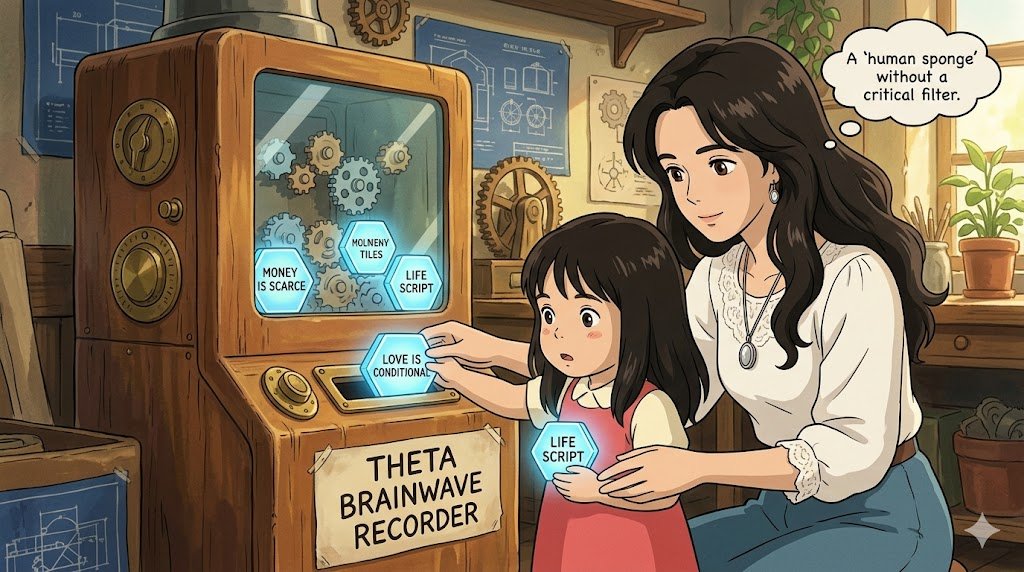
From birth to age seven, your brain exists primarily in a Theta wave state, making you a “human sponge.” Without a critical filter, you observe your environment and record observations as absolute truths. These unconscious core beliefs formed in childhood create your “Life Script.” If your early environment suggests that love is conditional or money is scarce, your adult brain will subconsciously seek to prove those “truths” right, even if they hurt you. Healing isn’t about changing who you are; it’s about updating the outdated software installed before you were old enough to consent to it.
Your Life is a 7-Year-Old’s Best Guess
You’re sitting in a high-stakes board meeting, or maybe you’re staring at a mounting pile of laundry, or perhaps you’re mid-argument with a partner who “just doesn’t get it.” In those moments, you think you’re the one in the driver’s seat. You think you’re a rational adult making logical choices based on current data.
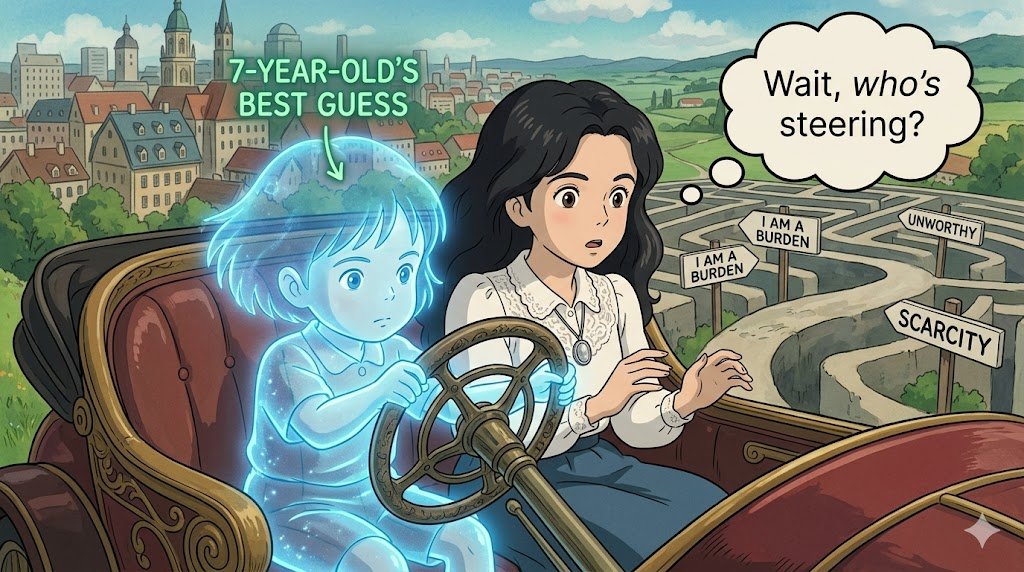
You’re wrong. Most of the time, you’re just a passenger. The person actually steering the car is a smaller, more confused version of you—the version that existed between the ages of zero and seven.
Think about the last time you felt “irrationally” angry or deeply unworthy. That wasn’t a “you” problem; it was a “program” problem. During those first seven years, your brain wasn’t analyzing life; it was downloading it. You didn’t have a filter to say, “Mom is just stressed about the mortgage.” Instead, your brain recorded: “I am a burden.” You didn’t have the logic to see that Dad’s absence was his own trauma. You simply coded: “I am not worth staying for.”
These aren’t just memories. They are unconscious core beliefs formed in childhood that act as the invisible architecture of your reality. They dictate who you marry, how much money you allow yourself to make, and how much “goodness” you feel you deserve.
In Humanity Deboism, we don’t look at these patterns to cast blame. Blame is a dead end. We look at them to find the “Source Code.” If your current life feels like a repetitive loop of “almost there” or “why does this always happen to me?”, it’s time to stop fighting the symptoms and start looking at the script. You aren’t broken. You’re just highly disciplined at following a set of rules you never wrote for yourself.
Let’s talk about how that script got written and, more importantly, why your brain thinks it’s still keeping you safe.
1. The Theta State—Why the First Seven Years are a “Download”
To understand your adult struggles, we have to look at the biology of a child’s brain. Adult brains usually operate in Beta (active thinking) or Alpha (relaxed reflection) frequencies. However, children under the age of seven live almost exclusively in Theta.
The Brain’s Developmental Blueprint: From Download to Defense
| Growth Phase | Brainwave State | Primary Age | The Biological Function | The “Humanity Deboism” Reality |
| The Infinite | Delta | 0 – 2 years | Pure sensation. No “I” vs. “Them.” | You aren’t thinking; you are feeling the safety or stress of your environment into your bones. |
| The Sponge | Theta | 2 – 7 years | Hypnotic suggestibility. No critical filter. | The Download Phase. Every observation about money, love, or worth is recorded as an absolute, immutable truth. |
| The Bridge | Alpha | 7 – 12 years | Developing the bridge between the inner and outer world. | You begin to create stories to justify the feelings you downloaded in the Theta phase. |
| The Executive | Beta | 12+ years | Analytical, logical, and critical thinking. | The Defense Phase. You use logic to protect your childhood beliefs, even if those beliefs are ruining your life. |
The Human Sponge Phase
In the scientific community, the Theta state is often compared to hypnosis. It is a state of hyper-suggestibility. Why would nature do this? Because a child needs to learn how to survive in their specific culture and family unit fast. You didn’t have time to “debate” whether your parents’ views on work or love were healthy; you needed to adopt them to belong.
The Construction of the “Truth”
During this period, your brain is building its “Internal Working Model.”
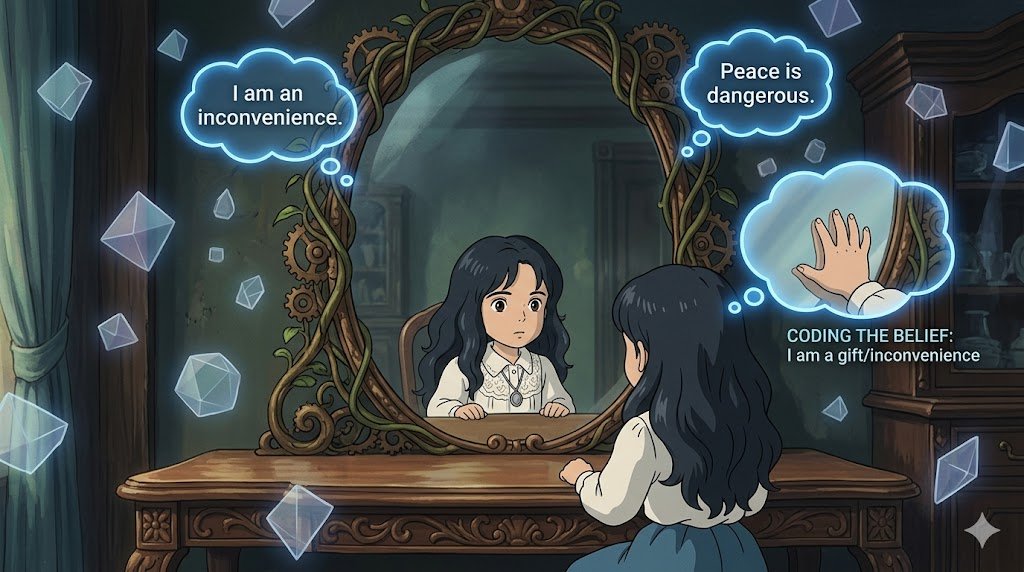
- The Mirroring Effect: If your primary caregivers reflected back joy when they looked at you, you coded the belief: “I am a gift.” If they reflected back frustration or indifference, you coded: “I am an inconvenience.”
- Environmental Osmosis: You didn’t just listen to what was said; you felt the “vibe.” If your home was a battlefield of silent tension, your nervous system learned that “Peace is dangerous” or “Wait for the other shoe to drop.”
These observations didn’t stay as thoughts. They became unconscious core beliefs formed in childhood. By the time you turned eight, the concrete had hardened. You spent the next several decades building a life on top of that foundation, never realizing that the cracks in your current relationships are actually gaps in a foundation poured thirty years ago.
2. The Architecture of Adult Sabotage
If your childhood was the “coding” phase, your adult life is the “output.” Most people spend their lives trying to fix the output—changing jobs, swapping partners, or reading every self-help book on the shelf—without ever looking at the source code.
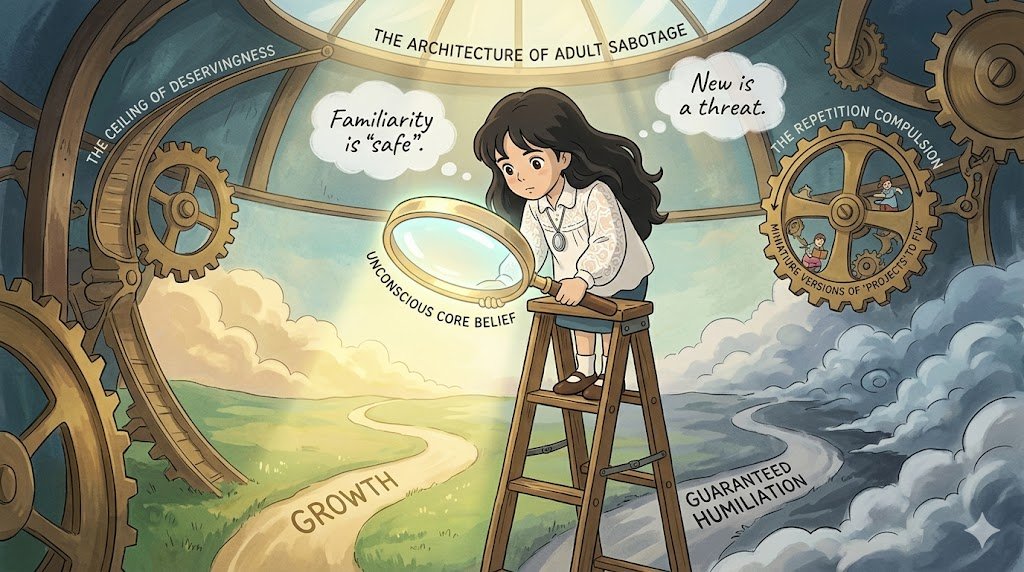
Unconscious core beliefs formed in childhood act as a filter through which every adult experience passes. This is why two people can look at the same opportunity and see two different worlds. One sees a chance to grow; the other sees a guaranteed humiliation.
This isn’t just “mindset.” It’s a biological survival mechanism. Your nervous system prioritizes familiarity over happiness. To your primal brain, what is familiar is “safe” because you survived it once. What is new is a threat.
How this shows up in your reality:
- The Ceiling of Deservingness: You work hard, you get the promotion, and then you suddenly get sick, pick a fight with your spouse, or blow the money on something useless. You’ve hit your “upper limit” of what your 7-year-old self believes you deserve.
- The Repetition Compulsion: You keep dating “projects”—people who need fixing or who are emotionally unavailable. Why? Because you’re trying to win a battle you lost at age five. You’re subconsciously trying to “fix” your parents through your partners.
- The Shadow of Perfectionism: If your early years taught you that love was a reward for performance (good grades, staying quiet, being “helpful”), you will likely become an adult who cannot rest. Your core belief is: “I only exist if I am useful.”
3. The Survival Loop—Why We Cling to Pain
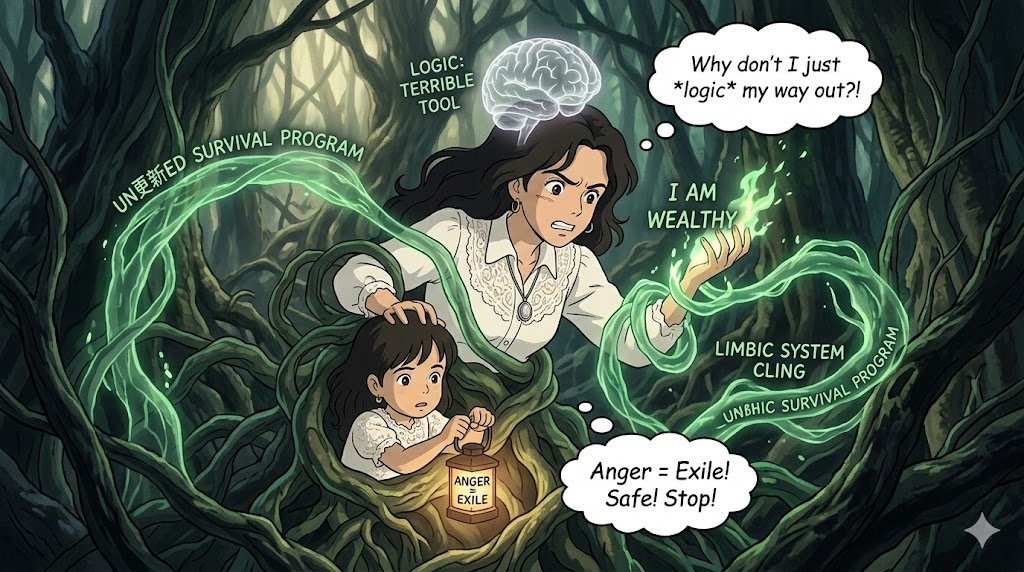
We often ask, “If these beliefs hurt me, why don’t I just let them go?” The answer lies in the Limbic System. Your brain isn’t designed to make you happy; it’s designed to keep you alive.
When you were three, if you learned that expressing anger led to being ignored, your brain coded “Anger = Exile.” As a thirty-year-old, you might have a boss who walks all over you. Logic tells you to speak up. But the moment you open your mouth, your limbic system screams, “Exile! Danger! Stop!” You freeze. You swallow the words. Then, you go home and beat yourself up for being “weak.”
You weren’t weak. You were being hijacked by a survival program that hasn’t been updated in twenty-five years.
The Reality Check: Why This Fails
Here is the uncomfortable truth: Logic is a terrible tool for healing. Most “transformation” programs fail because they try to solve a biological, deep-rooted problem with “positive thinking.” You cannot “affirm” your way out of a nervous system response. You can tell yourself “I am wealthy” 1,000 times a day, but if your unconscious core beliefs formed in childhood say that “Rich people are greedy and unloved,” your brain will sabotage your bank account to keep you “good” and “safe.”
Healing is messy. It involves “extinction bursts”—where the old behavior gets worse right before it dies. It involves physical discomfort, crying over things you thought you were “over,” and feeling like a fraud. If you think you can just “logic” your way into a new reality without feeling the friction in your body, you’re setting yourself up for another cycle of shame.
4. Mapping the Script: Belief vs. Reality
To change the script, you have to see it clearly. Here is how those early downloads translate into adult symptoms:
| Childhood Experience | Unconscious Core Belief | Adult Manifestation (The Symptom) |
| Caregiver was inconsistent | “I am not safe/stable.” | High anxiety, “waiting for the other shoe to drop,” clinginess in relationships. |
| Only praised for achievement | “I am only valuable when I produce.” | Workaholism, burnout, worth tied to bank account/status. |
| Parents fought about money | “Money is a source of conflict/pain.” | Self-sabotaging finances, fear of investing, “poverty consciousness.” |
| Emotional needs were ignored | “My voice doesn’t matter.” | People-pleasing, difficulty setting boundaries, “quiet” resentment. |
| “Golden Child” expectations | “I must be perfect to be loved.” | Severe fear of failure, procrastination, hiding mistakes. |
Debo’s Field Note #1: The Loyalty to the Wound
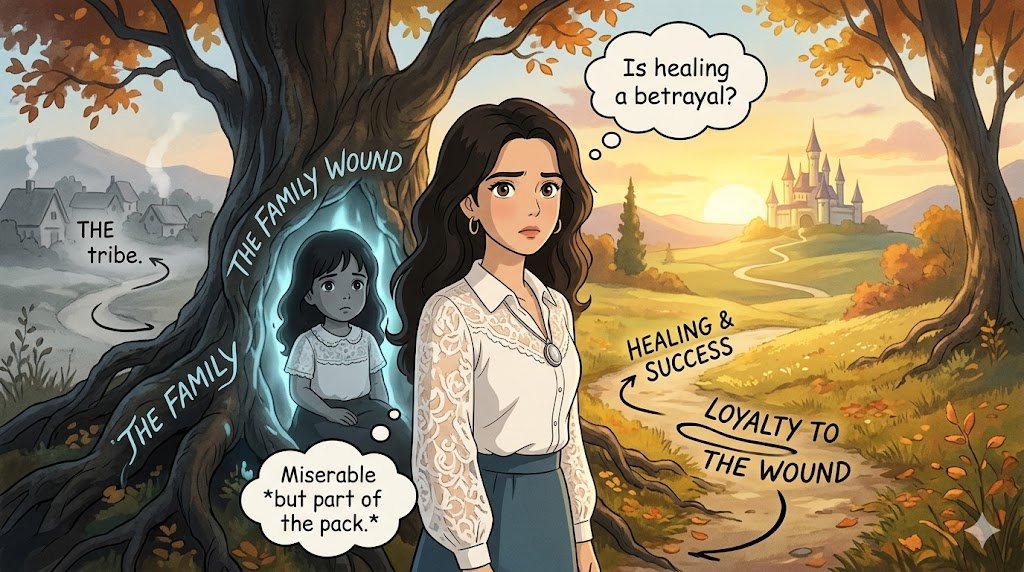
We are often more loyal to our childhood wounds than we are to our adult goals. Why? Because that wound is our connection to our family. To heal is to “betray” the family narrative. If everyone in your family is “struggling but honest,” your success feels like an exit from the tribe. Your brain would rather be “part of the pack” and miserable than “alone” and successful.
Debo’s Field Note #2: Secondary Gain
Ask yourself: “What do I get to avoid by staying stuck in this belief?” If you believe you are “unlovable,” you get to avoid the terrifying vulnerability of actually being seen. There is a “payoff” to your pain. Until you identify that secondary gain, your ego will fight your growth every step of the way.
5. The Alchemist’s Perspective—Your “Wound” is an Outdated Superpower
In most therapeutic circles, we talk about childhood programming as something to be “fixed” or “cured.” At Humanity Deboism, we take a different stance. We view your unconscious core beliefs formed in childhood not as defects, but as high-level survival adaptations.
Think about it. If you grew up in a home where you had to be the “peacekeeper” to avoid a blow-up, you didn’t just develop a “people-pleasing problem.” You developed a world-class ability to read a room, sense emotional shifts before they happen, and navigate complex interpersonal dynamics. That is a superpower.
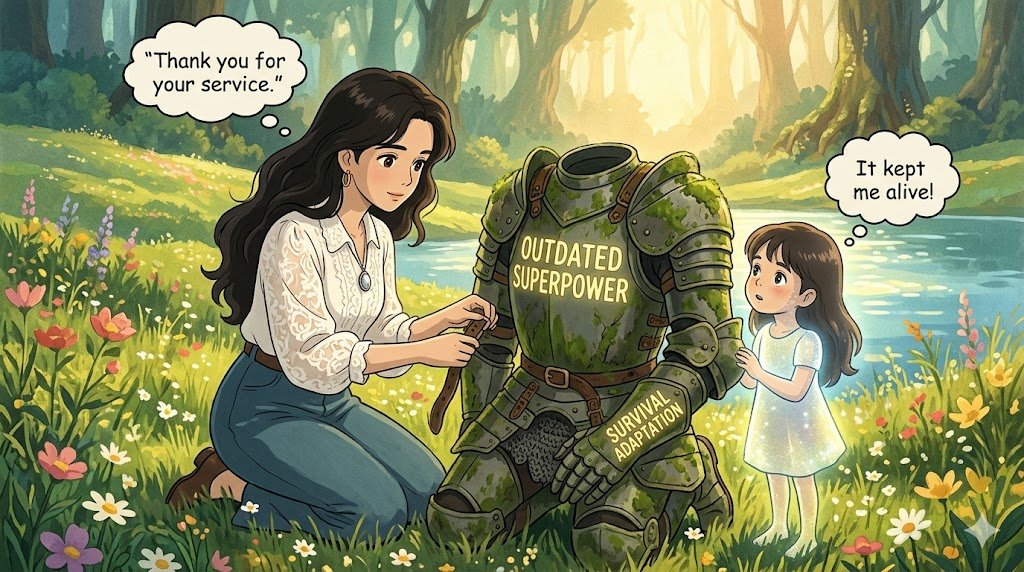
The issue isn’t that you are “broken.” The issue is that you are still using a survival strategy designed for a war that ended twenty years ago. You’re wearing a heavy suit of armor to a summer pool party. You aren’t “wrong” for wearing the armor—it kept you alive in the trenches—but you are currently overheating and unable to swim.
Healing is the process of acknowledging the armor, thanking it for its service, and slowly learning how to unbuckle the straps. We don’t “overcome” our childhood; we integrate it. We stop being the victim of the script and start becoming the Lead Editor.
6. The “Ghost in the Machine” and Information Gain
Most self-help focuses on “reparenting” or “inner child work” as a soft, ethereal concept. Let’s get more tactical. In the Deboism framework, we look at the Information Gain of your specific trauma.
Every negative core belief carries a hidden “data set.”
- The “I’m Not Enough” belief often carries the data of extreme resilience and high standards.
- The “World is Dangerous” belief carries the data of hyper-awareness and strategic thinking.
The breakthrough happens when you realize that you can keep the skill (the awareness) while discarding the belief (the fear). You can be a high-achiever without the “I must be perfect to be loved” gun held to your head. You can be discerning and safe without believing everyone is out to get you.
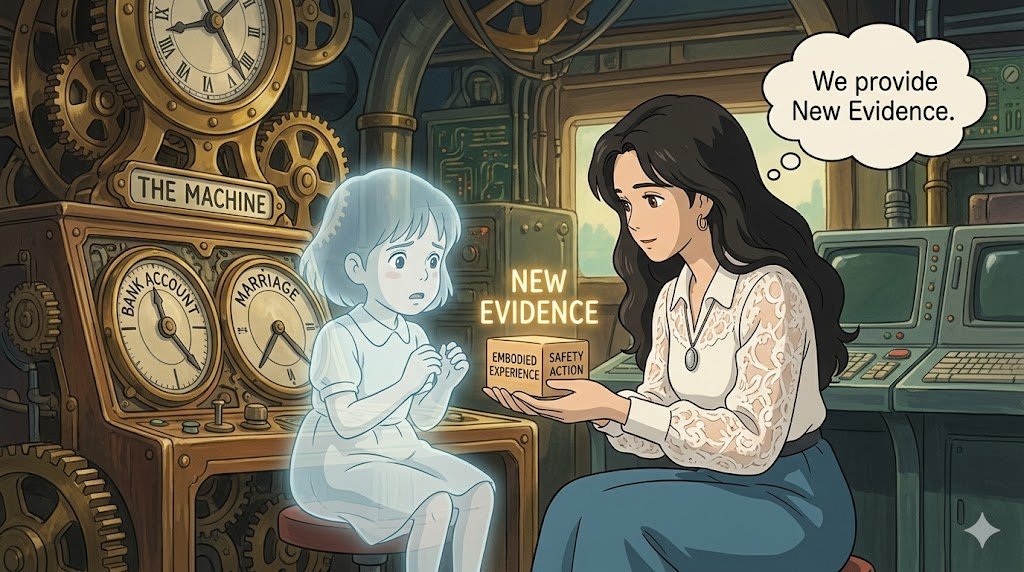
The “Ghost in the Machine” is that 6-year-old version of you who is still trying to manage your bank account or your marriage. They are doing their best with a very limited toolkit. Instead of yelling at the ghost for being scared, we have to provide it with “New Evidence.”
New Evidence isn’t a thought; it’s an embodied experience. Your brain won’t believe a new thought until your body feels the safety of a new action. This is where the gap between “knowing” and “doing” resides.
The Practice Bridge: From Theory to Bone-Deep Change
You can read articles about unconscious core beliefs formed in childhood until your eyes bleed, but insight alone is a “booby prize.” Insight doesn’t change neural pathways; deliberate practice does.
If you want to move from “understanding why you’re stuck” to actually “unsticking” the gears, you have to engage in the heavy lifting of the nervous system. We have to move the work out of the prefrontal cortex (the logic center) and into the body where the original “download” happened.
In the companion piece to this article, we get into the “How.” We move away from the “Why” and dive into the specific physical and mental drills required to intercept these loops in real-time. We’re going to teach you how to perform a “Belief Audit” and use “Pattern Interrupts” to stop the 7-year-old version of you from tanking your adult happiness.
Ready to start the work?
[Access the Day 1 Practice: The Core Belief Audit & Pattern Interrupt Drill here.]
(Note: This is also where you can find the Humanity Deboism “Source Code” Workbook to track your 60-day evolution.)
The Next Chapter: From Software to Hardware
We’ve spent this session digging through the “Source Code”—those unconscious core beliefs formed in childhood that act as the invisible script for your life. By now, you likely see the patterns. You see how a comment made by a kindergarten teacher or a look of disappointment from a parent created a neural pathway that you are still walking down today.
But here is where most people get stuck: Knowing isn’t doing. You can have the most profound “aha!” moment in the world, but if your heart is still racing and your throat still tightens when you try to set a boundary, the “aha!” doesn’t matter. This is because your core beliefs aren’t just thoughts stored in your mind; they are physical sensations stored in your nervous system.
Your 0-7 programming is the software. Your Limbic System—the emotional and survival center of your brain—is the hardware that runs it.
If you try to install “New Belief 2.0” (I am worthy of love) on hardware that is currently in “Survival Mode” (scanning for rejection), the system will crash. Every time. This is why you feel like you’re fighting yourself. You are trying to think your way out of a feeling problem.
In our next session, we move from the What to the How. We are going to stop looking at the script and start looking at the “Processor.” We will explore how to reach into the basement of the brain—the Limbic System—and manually reset the alarm. If today was about understanding the map, the next step is about actually learning how to drive the car without the 7-year-old version of you grabbing the steering wheel.
FAQ: Understanding Your Core Blueprint
1. Can I actually change beliefs formed before age seven?
Yes. While the brain is most plastic during those years, “neuroplasticity” is a lifelong feature. However, you cannot change them through logic alone; you must use “somatic” (body-based) tools to signal safety to the brain while introducing new evidence.
2. Does “Deboism” mean I should blame my parents for my current problems?
Absolutely not. Blame is a passive state that keeps you stuck in the victim role. We look at parents as people who were likely running their own faulty 0-7 scripts. Understanding the source isn’t about assigning guilt; it’s about taking responsibility for the “update” they weren’t capable of performing.
3. How do I identify a core belief if it’s “unconscious”?
Look at your “Repeaters.” What is the one thing that keeps happening in your life? If you keep getting passed over for promotions, your belief might be “It’s dangerous to be seen.” If you keep dating people who leave, it might be “I am fundamentally replaceable.” The “fruit” of your life always reveals the “root.”
4. Why does my body feel heavy or tired when I read this?
That is a “resistance response” from your nervous system. Your ego views these core beliefs as its identity. When you start poking at them, your brain triggers a “shutdown” or “boredom” response to get you to stop looking. It’s actually a sign you’re getting close to something real.
5. How long does it take to “overwrite” a core belief?
It’s not a one-time event; it’s a “tapering off.” You don’t stop having the old thought; you stop believing it and reacting to it. Over time, the old neural pathway withers from disuse, and the new one becomes the path of least resistance.
6. Can a single traumatic event after age 7 change my core beliefs?
Yes, high-impact trauma can create “Acute Core Beliefs.” However, even those are usually filtered through the original 0-7 foundation. A later trauma often “confirms” a suspicion you already had about the world from your early years.
7. Is “Inner Child” work just a hippie metaphor?
It’s a psychological shorthand for the “Neural Network” formed during your developmental years. When you “talk” to your inner child, you are actually engaging with the emotional centers of your brain that don’t process language but do process imagery and tone.
Links:
To get the most out of this journey, ensure you’ve grounded yourself in these previous and upcoming pillars:
- About Us: [What is Humanity Deboism? The Vision, The Mission and The Philosophy]
- The 3 Months: [Build the Best Version of Yourself and Break the Autopilot]
- Gumroad: [Resources for 3 Months]
- Sequence of 3 Months (Next): [Day 2: Healing Childhood Trauma: How to Regulate Your Limbic System]
Your brain has a “hidden button” that can shut down a panic attack or a self-sabotaging loop in less than sixty seconds—but you’ve been looking for it in the wrong part of your head.
The Humanity Deboism Source Code (References)
- Lipton, B. H. (2005). The Biology of Belief: Unleashing the Power of Consciousness, Matter & Miracles. Hay House. (On the Theta brainwave state and environmental programming in children ages 0–7).
- Bowlby, J. (1988). A Secure Base: Parent-Child Attachment and Healthy Human Development. Basic Books. (On the formation of “Internal Working Models” and early childhood attachment).
- Van der Kolk, B. (2014). The Body Keeps the Score: Brain, Mind, and Body in the Healing of Trauma. Viking. (On how childhood experiences are stored somatically in the limbic system).
- Berne, E. (1972). What Do You Say After You Say Hello? The Psychology of Human Destiny. Grove Press. (On the concept of the “Life Script” written in early childhood).
- Shore, A. N. (2012). The Science of the Art of Psychotherapy. W. W. Norton & Company. (On right-brain development and emotional regulation in early childhood).
- Doidge, N. (2007). The Brain That Changes Itself: Stories of Personal Triumph from the Frontiers of Brain Science. Penguin Books. (On neuroplasticity and the ability to rewire adult neural pathways).
- Siegel, D. J. (2012). The Developing Mind: How Relationships and the Brain Interact to Shape Who We Are. Guilford Press. (On the biological impact of caregiver mirroring on a child’s sense of self).
- Maté, G. (2022). The Myth of Normal: Trauma, Illness, and Healing in a Toxic Culture. Avery. (On the intersection of childhood conditioning and adult physical health).
Disclaimer: While we lean heavily into clinical research to ensure “EEAT” (Experience, Expertise, Authoritativeness, and Trust), this article is for educational purposes and is not a replacement for professional medical advice or psychiatric treatment.

Comments
Good job.
Keep it up!
Great work!
Wishing you a successful journey.
Post a Comment