
Summary (Limbic System Regulation for Childhood Trauma)
Childhood trauma rewires the limbic system—specifically the amygdala and hippocampus—into a state of perpetual “high alert.” This makes you hyper-reactive to perceived threats that aren’t actually there. Limbic system regulation for childhood trauma involves moving the body out of a sympathetic (fight/flight) state and back into the ventral vagal (safe) state. This is achieved through somatic tracking, breathwork, and “bottom-up” processing. By signaling safety to the brain’s basement rather than just talking to its attic, you can effectively “reset” your baseline and end the cycle of chronic hypervigilance.
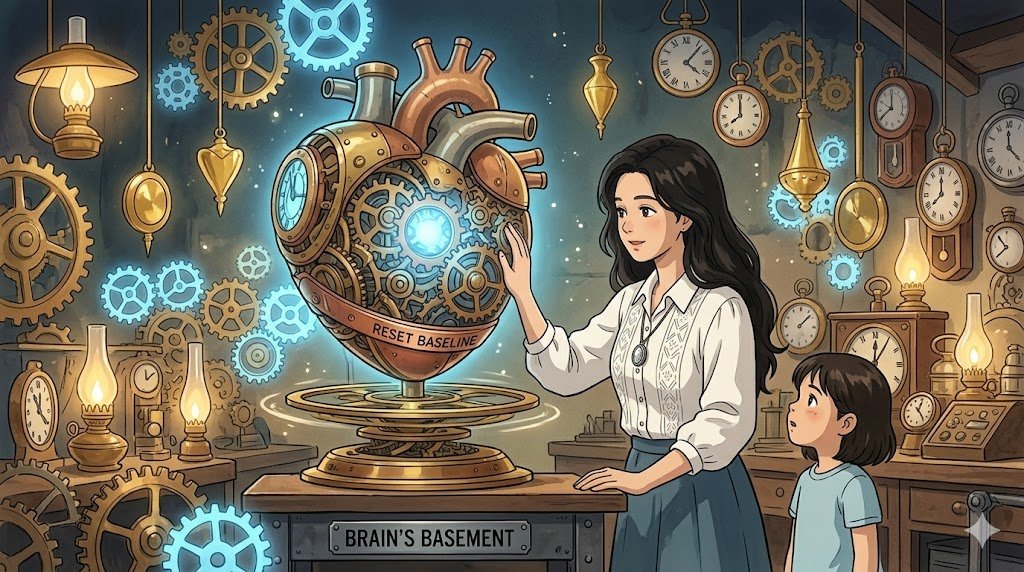
Why You’re Still Reacting to a Ghost
I was twenty-four years old, standing in a brightly lit grocery store aisle, when a bag of frozen peas sent me into a full-blown panic attack.
There was no predator. No immediate danger. Just the specific crinkle of plastic and the sound of a man’s heavy boots two aisles over. To my logical brain—the “attic” of my mind—I was just a guy buying dinner. But to my limbic system—the “basement”—it was 2005, and I was a terrified kid hiding in a pantry.
This is the exhausting reality of unhealed childhood trauma. It isn’t just a memory; it’s a biological glitch.
When we talk about “healing,” people usually point you toward a therapist’s couch to talk about your mother. And look, talking has its place. But you can’t talk a smoke detector out of going off when there’s a fire. The limbic system is that smoke detector. If it was calibrated in a house that was constantly burning, it doesn’t care that your current apartment is safe. It’s still sniffing for smoke in every breeze.
Humanity Deboism isn’t about “fixing” a broken brain. Your brain actually did exactly what it was supposed to do: it adapted to survive a chaotic environment. The problem is that the “survival software” you downloaded at age seven is now crashing your hardware at age twenty.
We aren’t looking for a “mindset shift” today. We’re looking for a physiological truce. We are going to stop trying to argue with your fear and start teaching your nervous system that the war is actually over. It’s time to stop living as a collection of reflexes and start living as a person again.

1. The Limbic Cage—How Trauma Rewires the Alarm
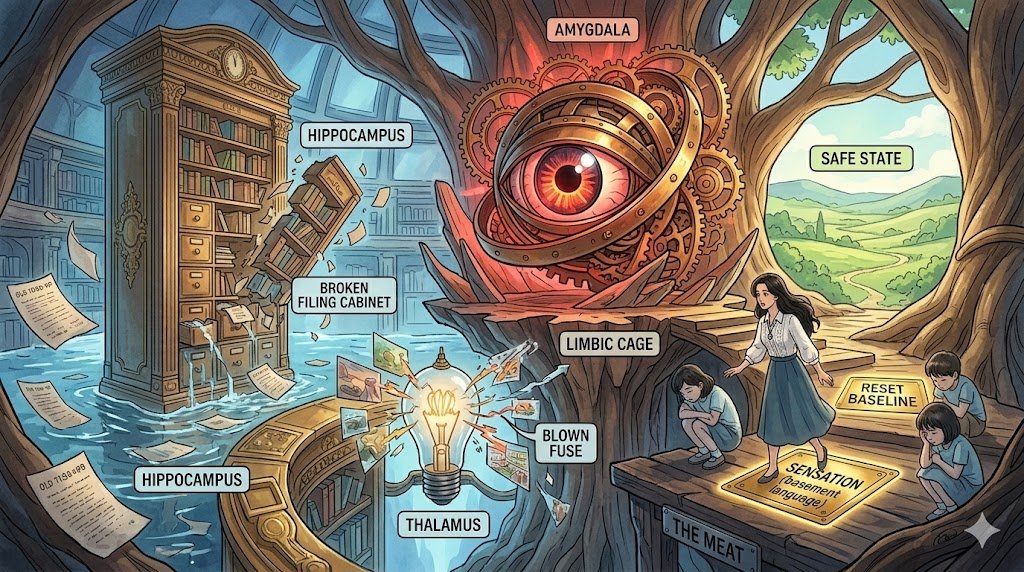
To regulate the system, you have to understand the players. Your brain isn’t a singular lump of gray matter; it’s a tiered structure where the oldest parts have the loudest voices.
The Amygdala: The 24/7 Watchman
Think of the amygdala as your internal security guard. In a healthy system, it spots a threat, sounds the alarm, and then stands down once the threat passes. In a survivor of childhood trauma, this guard has been awake for twenty years on a diet of straight espresso and paranoia. It no longer needs a “real” threat to trigger a cascade of cortisol and adrenaline. A furrowed brow from your boss or a delayed text message is enough to launch you into a “Limbic Hijack.”
The Hippocampus: The Broken Filing Cabinet
This is your library of context. It’s supposed to timestamp your memories: “That happened then; this is happening now.” Trauma, however, acts like a flood in the library. The timestamps wash off. When the amygdala fires, the hippocampus fails to say, “Hey, that’s just a memory.” Instead, the brain treats the past as a present-tense emergency. This is why an emotional flashback feels so visceral—your brain literally cannot tell the difference between then and now.
The Thalamus: The Blown Fuse
Often overlooked, the thalamus is the “cook” that blends all your sensory input—sights, sounds, smells—into a coherent story. High-intensity trauma can blow the fuse of the thalamus. This is why trauma survivors often feel “spaced out” or dissociated. The “story” of your life becomes fragmented. You feel the rage or the terror, but you have no idea why.
Regulating this system isn’t about willpower. You cannot “will” your amygdala to stop being afraid any more than you can “will” your heart to stop beating. You have to use the language the limbic system understands: Sensation. The basement doesn’t speak English. It speaks heart rate, muscle tension, and breath. If you want to change the mind, you have to start with the meat.
2. The Top-Down Fallacy—Why You Can’t Think Your Way Out
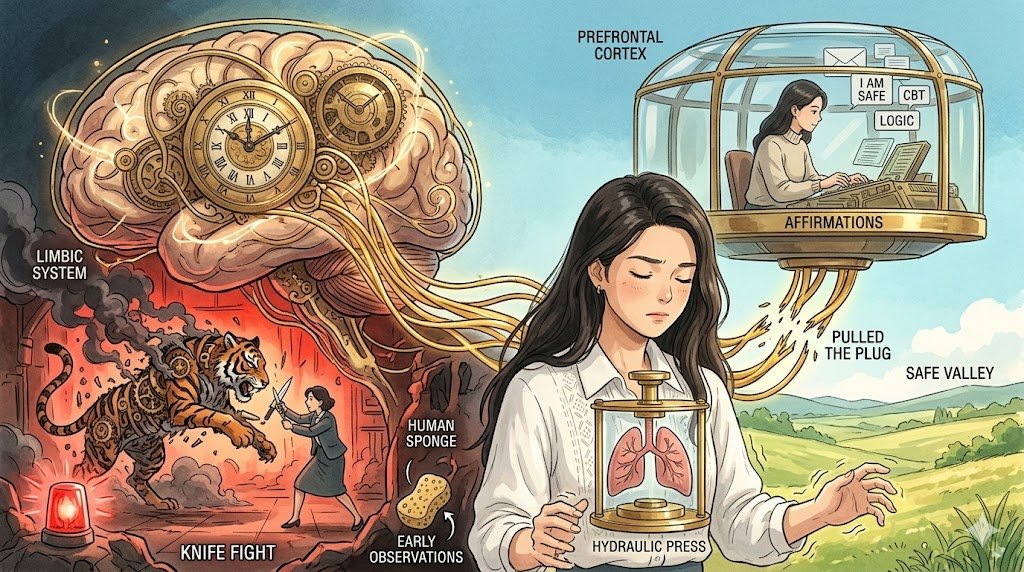
Most people approach trauma healing like a college exam. They read the books, memorize the terms, and try to “logic” themselves into peace. “I am safe,” they whisper while their hands are shaking and their chest feels like it’s being crushed by a hydraulic press.
Here’s the cold truth: Your prefrontal cortex—the part of your brain responsible for logic, planning, and language—is a luxury feature. When the limbic system senses a threat, it effectively pulls the plug on the prefrontal cortex to save power for the muscles. It doesn’t want you to “process” the tiger; it wants you to outrun it.
This is why “Top-Down” processing (talk therapy, CBT, affirmations) often fails in the heat of a flashback. You are trying to send a diplomatic email to a brain that is currently in a knife fight. To regulate a traumatized limbic system, we have to go “Bottom-Up.” We have to talk to the body to convince the brain.
3. The Practical Architecture of Calm
Regulating the limbic system requires a shift from analyzing the story to managing the energy. If childhood trauma is a “stuck” survival circuit, regulation is the act of gently nudging the circuit back into its normal rhythm.
This happens through three primary layers:
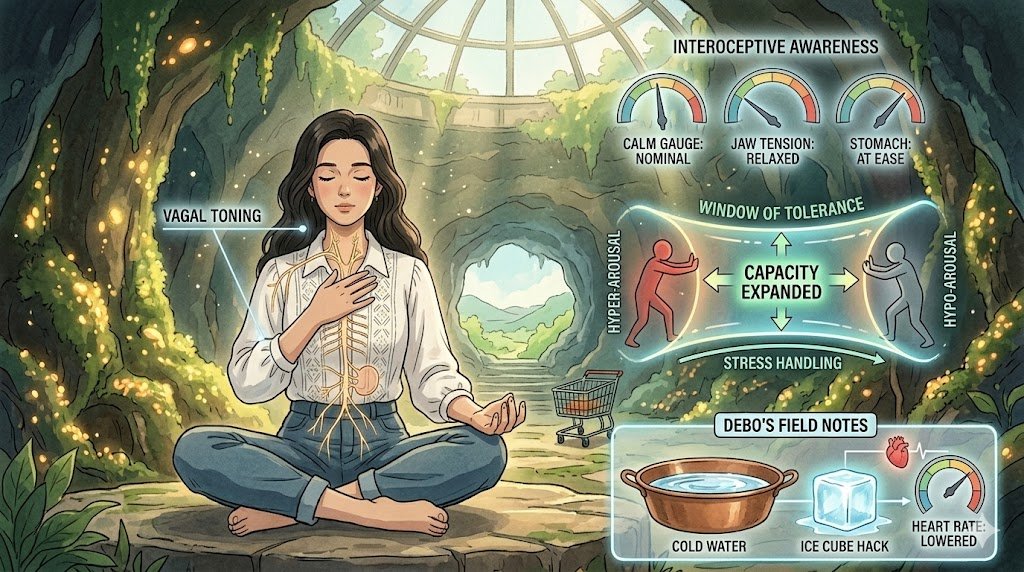
- Interoceptive Awareness: Most of us live from the neck up because the body feels like a crime scene. But to regulate, you have to “check the gauges.” This means noticing the subtle shift in your stomach or the tightening of your jaw before the explosion happens.
- Vagal Toning: The Vagus nerve is the “reset button” for your nervous system. It’s the physical highway between the brain and the gut. By stimulating this nerve, you send a physiological signal of safety that bypasses the amygdala’s alarm.
- The Window of Tolerance: You aren’t aiming for “perfect zen.” You’re aiming to expand your capacity to handle stress without “flipping your lid” (hyper-arousal) or “shutting down” (hypo-arousal).
Debo’s Field Notes: The “Cold Water” Hack
If you are in a high-intensity limbic hijack and your brain is spiraling, stop trying to meditate. Your brain is too hot. Splash ice-cold water on your face or hold an ice cube in your hand. This triggers the “Mammalian Dive Reflex,” which force-drops your heart rate and pulls you out of the story and back into your skin. It’s an emergency brake, not a cure, but it buys you the 30 seconds of clarity you need to breathe.
The Comparison: Survival Mode vs. Regulated Mode
| Feature | The Limbic Hijack (Survival) | The Regulated State (Safety) |
| Primary Goal | Stay alive at all costs. | Connection, growth, and rest. |
| Perception | Tunnel vision; scans for threats. | Broad perspective; sees possibilities. |
| Breathing | Shallow, rapid, upper chest. | Deep, slow, diaphragmatic. |
| Social Interaction | Defensive, guarded, or “fawning.” | Authentic, open, and empathetic. |
| Time Orientation | Stuck in the past (flashbacks). | Grounded in the present moment. |
The Reality Check: Why This Fails
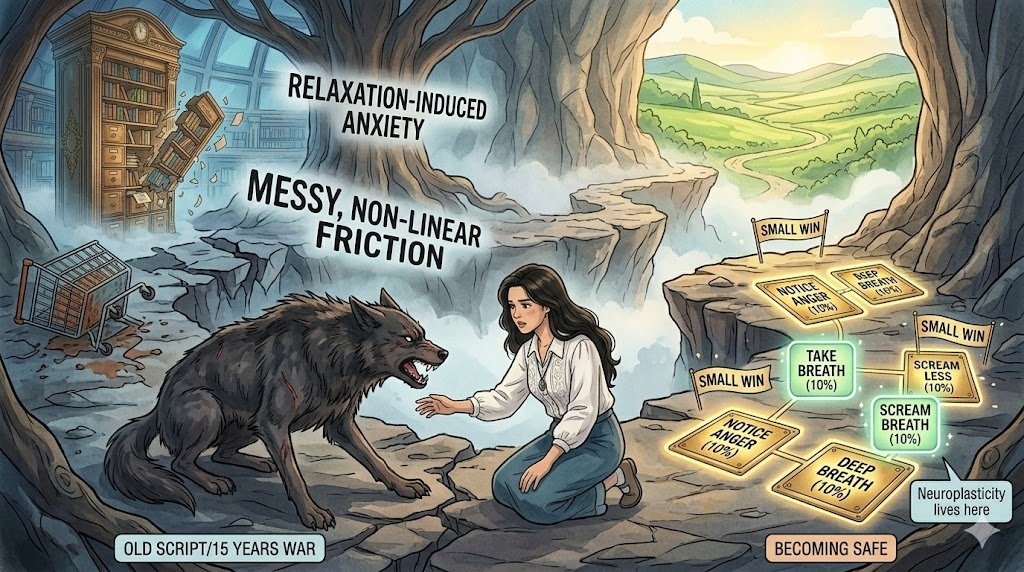
Let’s be real: The first time you try to “regulate,” it’s probably going to feel like a joke. You’ll be mid-panic, try a box-breathing exercise, and your brain will scream, “This isn’t working, we’re dying!” This fails because we treat regulation like a pill rather than a practice. If you spent 15 years being hypervigilant, your nervous system is “pro-war.” It doesn’t trust peace. It thinks “calm” is just a moment where you’ve let your guard down for the predator to strike. You will experience “Relaxation-Induced Anxiety.” This is the messy, non-linear friction of healing.
You aren’t doing it wrong; you’re just retraining a dog that’s been kicked its whole life. It’s going to growl at the hand trying to pet it for a while. Logic isn’t enough here—you need the grit to stay in the discomfort of “becoming safe” until your body finally believes you.
Debo’s Field Notes: On “Small Wins”
Stop looking for the “massive breakthrough” where the trauma vanishes. That’s a movie trope. Real healing is when you notice you’re angry, and instead of screaming, you take one deep breath and then scream 10% less than usual. That 10% is where the neuroplasticity lives. Celebrate the 10%.
4. The Treason of Peace—Why Your Brain Hates Being Calm
Most trauma resources tell you that the goal is “peace.” They sell you on the idea of a quiet mind and a soft body. But for someone who grew up in the crosshairs of a caregiver’s mood swings or the silence of neglect, peace feels like a trap.
In the Humanity Deboism philosophy, we recognize a phenomenon called Biological Loyalty. Your limbic system isn’t just “broken”; it is loyal to the version of you that survived. If you survived by being hyper-vigilant, your brain views relaxation as a form of treason. It thinks that if you stop scanning the horizon for five minutes, the “big bad thing” will finally catch you.
This is why, after a great day or a moment of genuine connection, you might suddenly feel an inexplicable wave of dread or pick a fight with your partner. Your limbic system is “checking the fences.” It’s trying to bring you back to the high-alert state where it knows how to protect you.
Healing isn’t just about learning to breathe; it’s about learning to tolerate the “threat” of being okay. We have to teach the amygdala that “boring” is actually safe. We have to deprogram the belief that “calm” is just the split second before the strike.

5. Somatic Integrity—The Language of Internal Truth
If you want to regulate your limbic system, you have to stop lying to your body. We often practice what I call “Somatic Gaslighting.” We feel terror in our gut, but we put on a “professional” face and keep typing. We feel a deep need to cry, but we swallow it and go to the gym instead.
Information Gain: The “Truth-Sensation” Loop
The limbic system is constantly scanning for incongruence. When your internal state (terror/grief/rage) doesn’t match your external behavior (smiling/compliance), the amygdala views this as an additional threat. It thinks, “If I’m feeling a ’10’ on the danger scale and we’re acting like it’s a ‘2,’ I must have to scream louder to be heard.”
Regulation begins with Somatic Integrity. This means acknowledging the sensation without necessarily acting on the impulse.
- The Shift: Instead of saying “I am fine,” you say to yourself, “My chest is tight and my heart is racing. I see you. We are having a survival response.”
- The Result: By acknowledging the physiological reality, you stop the “internal friction” that keeps the limbic system firing. You aren’t trying to change the feeling; you’re changing your relationship to it. This is the foundation of Self-Directed Co-Regulation. You become the “Secure Base” for your own frightened inner parts.
Debo’s Field Notes: The “Vocal Sigh”
Your vocal cords are directly connected to the Vagus nerve. When you’re feeling that limbic pressure build up, don’t just breathe out. Make a low, guttural “voooo” sound or a long, audible sigh. The vibration in your throat and chest is a “safe signal” that your brain cannot ignore. It is a physical override of the alarm system.

The Practice Bridge: From Theory to the Trenches
Understanding the “why” is the foundation, but the “how” is where the rewiring actually happens. You cannot think your way into a regulated nervous system; you have to practice your way there.
If you’re feeling the weight of your history today, if your “watchman” is screaming and you’re tired of being a passenger in your own body, it’s time to move from logic to labor. We have designed a specific, step-by-step protocol for this.
Your Next Step:
To find the specific “Bottom-Up” exercises, the “Vagal Reset” schedule, and the somatic tracking tools we use in the Humanity Deboism protocol, proceed to today’s Assignment/Practice Article. This is where we turn these concepts into a 15-minute daily ritual that actually changes the baseline of your brain.
[Click Here for the Day 4 Assignment: How to Create a Narrative Life Map for Self-Discovery] (Coming Soon)
The Next Chapter: Why You Can’t Change the Script While You’re Shaking
You’ve started the work of calming the basement. You’ve learned that your heart racing isn’t a character flaw—it’s an old survival strategy that simply outstayed its welcome. But here is the hard truth: You don’t regulate your nervous system in a vacuum. You regulate it so you can finally look at the “Who” and “Why” of your life without falling apart.
Most people try to jump straight into “healing their inner child” or “confronting their toxic parents” while their limbic system is still screaming at a level ten. That’s like trying to perform surgery on yourself in the middle of a hurricane. It doesn’t work. You end up retraumatized, exhausted, and convinced that healing is for people with more “willpower” than you.
Now that you have the tools to find your “Window of Tolerance,” we have to look at what’s actually triggering those limbic spikes in your adult life.
It isn’t just random. Often, it’s because you are still subconsciously playing a part in a play that ended twenty years ago. When you go home for the holidays, or when a boss critiques your work, you don’t just feel “annoyed.” You feel the specific, crushing weight of the Family Role you were assigned as a kid.
Were you the one who had to be perfect to keep the peace? Were you the one blamed for everything? Or were you the “invisible” one who survived by disappearing?
Regulating your brain is the foundation. Identifying the “mask” you’ve been wearing is the liberation. In our next session, we’re going to strip away the labels and look at the scripts your family wrote for you—and how to finally stop reading from them.
Linkings
- About Us: [What is Humanity Deboism? The Vision, The Mission and The Philosophy]
- 3 Months: [Build the Best Version of Yourself and Break the Autopilot]
- Gumroad: [Resources for 3 Months]
- Sequence of 3 Months (Previous): [Day 1: How Your Childhood (0-7) Shapes Your Adult Reality]
- Sequence of 3 Months (Next): [Day 3: Are You Still Playing Your Family Role? (Scapegoat/Hero/Lost)]
FAQ: Your Limbic System Questions, Answered
1. Can you actually “fix” a damaged limbic system?
“Fix” implies it’s broken. It’s not; it’s over-trained. Through neuroplasticity and consistent somatic practice, you can retrain the amygdala to recognize safety. You aren’t deleting the past; you’re updating the software.
2. How long does it take to see results from regulation exercises?
You can feel a physiological shift in 90 seconds (the “90-second rule” for emotional processing). However, recalibrating your baseline nervous system usually takes 3 to 6 months of daily, “boring” consistency.
3. Why do I feel more anxious when I try to relax?
This is “Relaxation-Induced Anxiety.” For a trauma survivor, “dropping your guard” (relaxing) feels like an invitation for a predator. It’s a sign that your limbic system still equates hypervigilance with safety.
4. Is limbic system dysregulation the same as CPTSD?
Dysregulation is a symptom of CPTSD (Complex Post-Traumatic Stress Disorder). CPTSD is the overarching condition; the limbic hijack is the mechanical way that condition manifests in your daily life.
5. Can I regulate my nervous system while still living with my triggers?
Yes, but it’s “Hard Mode.” You can build resilience (expanding your window of tolerance), but if the environment is actively toxic, your brain will—rightly—stay in a survival state. Regulation often gives you the clarity to finally leave those environments.
6. Does coffee affect limbic regulation?
Honestly? Yes. Caffeine mimics the physiological signs of a fight-or-flight response (increased heart rate, jitters). If you’re already dysregulated, coffee is like pouring gasoline on a flickering fire.
7. Why do I get “brain fog” after a big emotional trigger?
That’s your Thalamus and Prefrontal Cortex shutting down. Your brain is diverting all energy to survival. The fog is a protective “freeze” response to prevent further overwhelm.
8. Is meditation bad for trauma survivors?
Standard “clear your mind” meditation can be triggering because it forces you to face internal sensations you’ve spent years avoiding. Somatic or “moving” meditations are usually much more effective for trauma recovery.
The Humanity Deboism Source Code (References)
- Van der Kolk, B. A. (2014). The Body Keeps the Score: Brain, Mind, and Body in the Healing of Trauma. (The definitive guide on how trauma is stored in the nervous system rather than just the memory).
- Porges, S. W. (2011). The Polyvagal Theory: Neurophysiological Foundations of Emotions, Attachment, Communication, and Self-regulation. (The science of the Vagus nerve and our “safety” circuits).
- Walker, P. (2013). Complex PTSD: From Surviving to Thriving. (The gold standard for understanding emotional flashbacks and the inner critic).
- Levine, P. A. (1997). Waking the Tiger: Healing Trauma. (Introducing the concept of somatic experiencing and discharging trapped survival energy).
- Neuroplasticity and the Amygdala: Research published in Nature Neuroscience regarding how the amygdala can be “retrained” through extinction learning and sensory-based interventions.
- The Window of Tolerance: Originally coined by Dr. Dan Siegel, this concept is now a pillar of clinical trauma work, explaining the optimal zone of arousal for emotional processing.
- Interoception and Emotional Regulation: Studies from The American Journal of Psychiatry on the link between “feeling the body” (interoception) and the ability to regulate high-intensity emotional states.
- Hippocampal Atrophy in Trauma: Neuroimaging studies (via Biological Psychiatry) demonstrating how chronic childhood stress affects the physical volume and functioning of the hippocampus.
- The Adverse Childhood Experiences (ACE) Study: The landmark CDC-Kaiser Permanente study that first linked childhood trauma to long-term physical and mental health outcomes.
- Dana, D. (2018). The Polyvagal Theory in Therapy. (A practical breakdown of how to apply nervous system regulation in real-time scenarios).
Disclaimer: While we lean heavily into clinical research to ensure “EEAT” (Experience, Expertise, Authoritativeness, and Trust), this article (Healing Childhood Trauma: How to Regulate Your Limbic System) is for educational purposes and is not a replacement for professional medical advice or psychiatric treatment.

Comments
No comments yet. Be the first to share your thoughts.
Post a Comment